Basset Hound Training: The Complete Guide for Owners
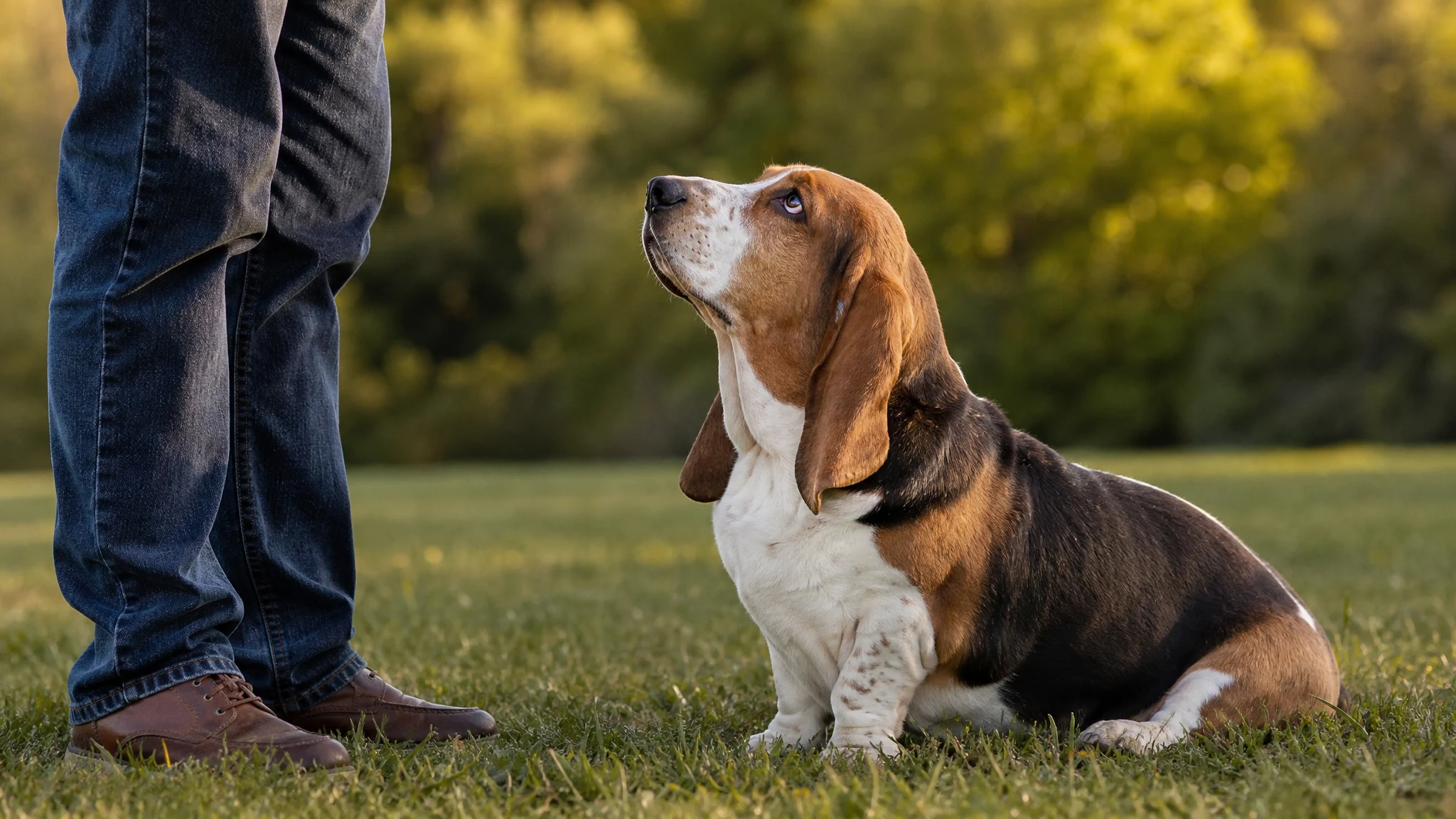
General training information. Every dog is an individual; for health or behavior concerns, see your veterinarian.
Anyone who has watched a Basset Hound put its nose to the ground knows the look. The ears drag, the tail goes up, and the dog stops hearing a word you say. That moment explains most of what you need to know about Basset Hound training.
This guide covers what the breed was made to do, how that shapes the way you teach, what a sensible training plan looks like from puppy to adult, which rewards work, how much exercise and mental work the breed needs, and the challenges to plan for. Every method here is humane and reward-based, in line with the American Veterinary Society of Animal Behavior (AVSAB).
Table of Contents
- What the Basset Hound Was Bred For
- How Temperament Shapes Training
- Training Stages: Puppy to Adult
- Motivation That Works for This Breed
- Exercise and Mental Work
- Challenges to Plan For
- Sports, Jobs and Goals Beyond Good Manners
- Sources
Key Takeaways
- The Basset Hound is a scent hound. The Basset Hound Club of America says the breed was developed to hunt small game such as rabbit and hare by scent, working in packs for hunters on foot.
- Hill's Pet Nutrition describes the breed as not easy to train and somewhat stubborn. Think "independent thinker," not "unwilling."
- Start training the day the puppy comes home. Vetstreet advises against waiting until 6 months.
- Be consistent and patient. Positive reinforcement works, and the breed's strong interest in food helps (PetMD, via Vetstreet).
- Orvis says a Basset must be leashed or fenced because of the urge to follow scents.
- Plan for loud howling and for weight gain. Orvis flags the first, and Hill's flags obesity.
- Individual dogs vary. Use breed information as a starting point, then train the dog in front of you.
What the Basset Hound Was Bred For
Every breed's training problems start with its job. For the Basset Hound, the job was following a trail.
A scent hound from France
The Basset Hound Club of America (BHCA), the parent club, traces the breed to France. Sources do not agree on the date. The BHCA dates the breed to sixth-century France, the United Kennel Club (UKC) says possibly as early as 1585, and Hill's Pet Nutrition says the 1500s in France, with refinement in England in the 1800s. If a date matters to you, treat all of these as approximate.
The UKC groups the Basset Hound as a Scenthound. For help with the AKC group, check the American Kennel Club directly.
The original work
According to the BHCA, Bassets hunted small game such as rabbit and hare by scent. Packs of Bassets drove prey out of dense cover for hunters on foot. A dog like that needs a few things:
- A nose that stays on a trail for a long time.
- The drive to keep going when something interesting is ahead.
- Enough independence to work through cover without waiting for instructions.
- A voice that carries. The UKC mentions a deep, melodious voice, and Orvis says the breed howls loudly.
Those traits are not flaws. They are the breed doing exactly what it was built for, in a living room instead of a field.
Size and build, with ranges
Published sizes vary. Vetstreet lists a height of no more than 14 inches, the UKC gives 13 to 15 inches at the withers, and Hill's lists males at 14 inches and females at 13 inches. For weight, Vetstreet lists 50 to 65 pounds, PetMD says 40 to 65 pounds, and Hill's gives 40 to 80 pounds in its text. Since the numbers differ, use them as a rough range and ask your veterinarian what a healthy weight looks like for your own dog.
The BHCA also notes that the club's breed standard has been unchanged since 1964. For the full standard, go to the club's site.
How Temperament Shapes Training
Friendly and affectionate
The UKC describes the Basset Hound as friendly and affectionate, and never aggressive or timid. Vetstreet calls the breed good-natured, independent and ruled by the nose. That mix is useful. A dog that likes people and is not fearful is usually pleasant to work with, as long as the training matches what the dog finds rewarding.
I will not make claims here about how the breed gets along with children or with other dogs. The sources used for this guide do not cover it, so check with the BHCA or a reputable breeder, and judge each dog on its own behavior.
Independent, not unintelligent
Hill's says the breed is not easy to train and is somewhat stubborn. The BHCA describes Bassets as independent thinkers who still do well in Obedience, Rally and Agility.
Put those two statements together and a useful picture emerges. A Basset can learn. What it will not do is hang on your every word the way a dog bred to work closely with a handler might. Your cue has to compete with the smell of the yard, so you need to make your cue worth answering.
What this means in practice
- Keep sessions short and clear. End while the dog is still interested.
- Pay well. If the dog ignores a cue, the reward may be too small for the distraction. It is rarely defiance.
- Manage the environment. Use leashes, fences and gates so the dog cannot practice the wrong thing.
- Expect slower progress than you would see in some other breeds. That is normal for this breed, not a sign you are doing it wrong.
Training Stages: Puppy to Adult
This guide does not give a week-by-week development chart for the breed, because the sources used here do not provide one. Ask your veterinarian or the BHCA about developmental timing. What follows is a sensible order of priorities, not a calendar.
Stage 1: The day the puppy comes home
Vetstreet is clear: start the day the puppy comes home, and do not wait until 6 months. Waiting gives a scent-driven puppy months to practice habits you will later have to undo.
Early priorities:
- A routine. Meals, potty breaks, naps and play at predictable times.
- Potty training. Take the puppy out often, reward in the right spot, and supervise indoors.
- A comfortable crate or pen. Introduce it slowly with treats and a chew, never as punishment.
- Name and eye contact. Reward every time the puppy looks at you. This builds the habit of checking in, which matters a lot for a nose-driven dog.
- Gentle handling. Practice touching paws, ears and mouth with treats, so grooming and vet visits are easier later.
Stage 2: Foundation manners
Once the routine is settling, teach the basics in short, happy sessions:
- Sit and down. Lure with a treat, mark the moment the position happens, and reward.
- Come. Start indoors. Say the cue once, back away or crouch, and pay generously when the puppy arrives. Never call the dog to you for something unpleasant.
- Leave it. Valuable for a dog that lives by its nose.
- Loose-leash walking. Reward the dog for being beside you, and stop moving when the leash goes tight.
- Settle on a mat. A calm default behavior helps a lot in a house with a dog that likes to follow every smell.
Teach each skill in a quiet room first, then in the yard, then on walks. Dogs do not generalize well. A "come" that works in the kitchen may mean nothing at the park.
Stage 3: Socialization and real-world practice
Introduce the puppy to people, surfaces, sounds and places at a pace the puppy can handle. Ask your veterinarian which outings are safe before vaccinations are complete. Keep experiences positive and short. If the puppy backs off, give space and try an easier version later. Pairing new things with treats teaches the puppy that the world is a good place.
Stage 4: Adolescence
Many owners find that a trained puppy seems to forget everything for a while. Do not panic and do not get harsher. Go back to basics, shorten sessions, raise the value of the rewards, and keep management tight. For a Basset, that usually means more leash time and fewer chances to wander off on a trail.
Stage 5: Adulthood
Adult training is maintenance and enrichment. Keep practicing the cues you rely on, especially recall and leave it. Add new activities so the dog keeps using its brain. A well-practiced adult Basset still has a nose, so keep the leash and the fence.
Motivation That Works for This Breed
Food is the obvious lever
PetMD, as summarized by Vetstreet, says positive reinforcement works for this breed, helped by strong food motivation. That gives you a clear tool. Small, soft, smelly treats are easy to deliver fast and are easy for a hound to notice.
A few ways to use food well:
- Cut treats small. Pea-sized pieces keep the session going without a calorie problem.
- Use part of the daily meal. Measure the day's food and use some of it as training rewards.
- Vary the value. Use ordinary treats at home and something special for the hardest jobs, like coming away from a scent.
- Fade the lure early. Show the treat once or twice to guide the dog, then hide it and reward after the behavior.
Because Hill's lists obesity as a challenge for the breed, watch the total. Ask your veterinarian how much your dog should eat each day and how to count treats.
The nose can be a reward too
Here is a trick that suits a scent hound. Use sniffing as a reward. Ask for a short loose-leash walk or a sit, then release the dog with a cue like "go sniff." The dog learns that doing what you ask opens the door to the thing it wants most. This turns the breed's biggest distraction into a paycheck.
Praise and play
Praise, a calm pet, and a short game can all work. Use whatever your dog loves best. Just do not rely on praise alone for hard tasks. If the dog is choosing between you and a rabbit trail, a pat on the head will lose.
What to avoid
Shock, prong and choke collars, alpha rolls, scruffing and other dominance methods have no place in this plan. They are not in line with AVSAB guidance. They can also make a friendly dog wary of you. A Basset described as friendly and never timid by the UKC deserves methods that keep it that way.
If a cue is not working, the usual causes are a reward that is too small, a distraction that is too big, or a cue the dog does not yet understand. Change one of those things, not the dog's comfort.
Exercise and Mental Work
How much exercise
Hill's says a Basset needs a good long walk at least once a day and is not built for daily running. Orvis suggests two to three 20-minute walks plus easy play. Because these two sources give slightly different pictures, treat them as a range and ask your veterinarian what suits your dog's age, weight and health.
Keep an eye on the dog's weight and joints. Sources used here flag obesity, so steady, moderate activity is a better fit than hard running. For anything about pain, limping or movement, talk to your veterinarian rather than guessing.
Walks as training time
A walk is a good place to practice. Let the dog sniff on a longer leash in a safe spot, and ask for a few cues along the way. Mix it up:
- Walk a familiar route for relaxed practice.
- Visit a new area for added smells and more focus work.
- Stop now and then, ask for a sit, and reward.
- Allow decompression time, where the dog just sniffs.
Brain games that suit a scent hound
Mental work can tire a hound as much as a long walk. Ideas that use the nose:
- Scatter feeding. Toss part of a meal into the grass or a snuffle mat.
- Hide and seek with treats. Hide a few in easy spots at first, then make it harder.
- Find it. Drop a treat on the floor and cue "find it." Later, hide it in another room.
- Food puzzles and chews. Good for rainy days and quiet time.
- Simple tracking games. Drag a treat along the ground in a short line, and let the dog follow it.
These games also build the thing you need most, a dog that enjoys working with you. The BHCA lists Tracking among the activities Bassets take part in, so this kind of work is a natural fit.
Challenges to Plan For
Orvis, Vetstreet and Hill's name a handful of challenges. Here is how to approach each one.
Scent drive
Orvis says the breed must be leashed or fenced because of the urge to follow scents. This is the single most important safety rule. A Basset on a trail can ignore a call, a car, or a road.
- Use a leash anywhere that is not securely fenced.
- Check the fence for gaps and low spots. A hound will find them.
- Practice recall on a long line before you ever trust it off leash, and be honest about whether you ever should.
- Use a harness that fits well so a sudden lunge does not strain the dog's neck.
Stubbornness and the independent streak
Vetstreet and Hill's both point to stubbornness and independence. When your Basset ignores a cue, do not repeat it ten times. Repeating teaches the dog that the cue is optional.
- Say the cue once.
- If the dog does not respond, quietly make it easy: move closer, show a treat, or reduce the distraction.
- Reward the response.
- Next time, set the dog up to succeed from the start.
Consistency matters. Everyone in the household should use the same cues and the same rules. If one person allows couch time and another does not, the dog will not know which rule applies.
Loud howling
Orvis says the breed howls loudly and may howl when left alone too long. The UKC calls the voice deep and melodious, which sounds charming until your neighbors hear it at midnight.
What helps:
- Exercise and mental work before alone time. A tired, fed dog settles more easily.
- Short, gradual practice at being alone. Start with a few minutes and build up slowly.
- A chew or food toy for the first part of your absence.
- Reward quiet. Notice and pay for calm moments, instead of only reacting to noise.
- No punishment. Yelling or scolding can add stress. If howling is intense or comes with panic, ask your veterinarian or a qualified behavior professional for help.
Do not expect a Basset to be a quiet breed. Aim for manageable, not silent. If you live in an apartment or share walls, think carefully about this before you bring a puppy home.
Weight
Hill's lists obesity as a challenge. A food-motivated dog that is not built for daily running can gain weight quickly if portions and treats are not tracked.
- Measure meals instead of free feeding.
- Count training treats as part of the day's food.
- Use low-calorie rewards, such as tiny bits of a safe food your veterinarian approves.
- Ask your veterinarian to check your dog's weight and body condition at visits.
Grooming and shedding
Sources disagree on how much work coat care takes. Orvis says the breed sheds heavily and recommends daily brushing. Hill's says grooming is fairly quick and easy, with brushing once or twice a week typically enough. Start with a regular schedule and adjust to your own dog. Grooming is also a training chance. Pair the brush with treats so handling stays pleasant.
Health questions
Health screening and common health issues for the breed are not covered in the sources used here. For health screening recommendations, check with the BHCA and the Orthopedic Foundation for Animals, and bring all health questions to your veterinarian. If your dog seems to be in pain or has a sudden change in behavior, see your veterinarian before assuming it is a training problem.
Sports, Jobs and Goals Beyond Good Manners
The BHCA lists a wide range of activities for the breed: Conformation, Field Trials, Hunt Performance Tests, Tracking, Obedience, Rally, Agility and Therapy Dog work. You do not need to compete to benefit from the ideas.
- Tracking and hunt-style tests use what the breed was built to do.
- Obedience and Rally give structure and a goal for your training plan.
- Agility shows that a short-legged hound can enjoy a course. Ask your veterinarian whether it suits your dog's body and age.
- Therapy Dog work suits dogs with a friendly nature, but a dog must be calm and reliable in public to qualify.
If you want to try a sport, contact the BHCA or a local club for guidance. Do not rely on a trainer or program you cannot verify.
A simple plan to start this week
- Set up a fenced area or leash routine, so your dog cannot follow a trail alone.
- Pick three rewards, one ordinary, one better, and one special.
- Practice sit, name, and "leave it" for three to five minutes, twice a day.
- Add one nose game a day.
- Weigh the daily food and set aside training treats from it.
- Write down the rules so the whole household uses the same ones.
Basset Hound training rewards patience. If you accept the nose, pay well and stay consistent, you will usually end up with a calm, affectionate companion, and a dog that still stops in its tracks to read the news in the grass.