Crate Training a Basset Hound and Preventing Separation Anxiety
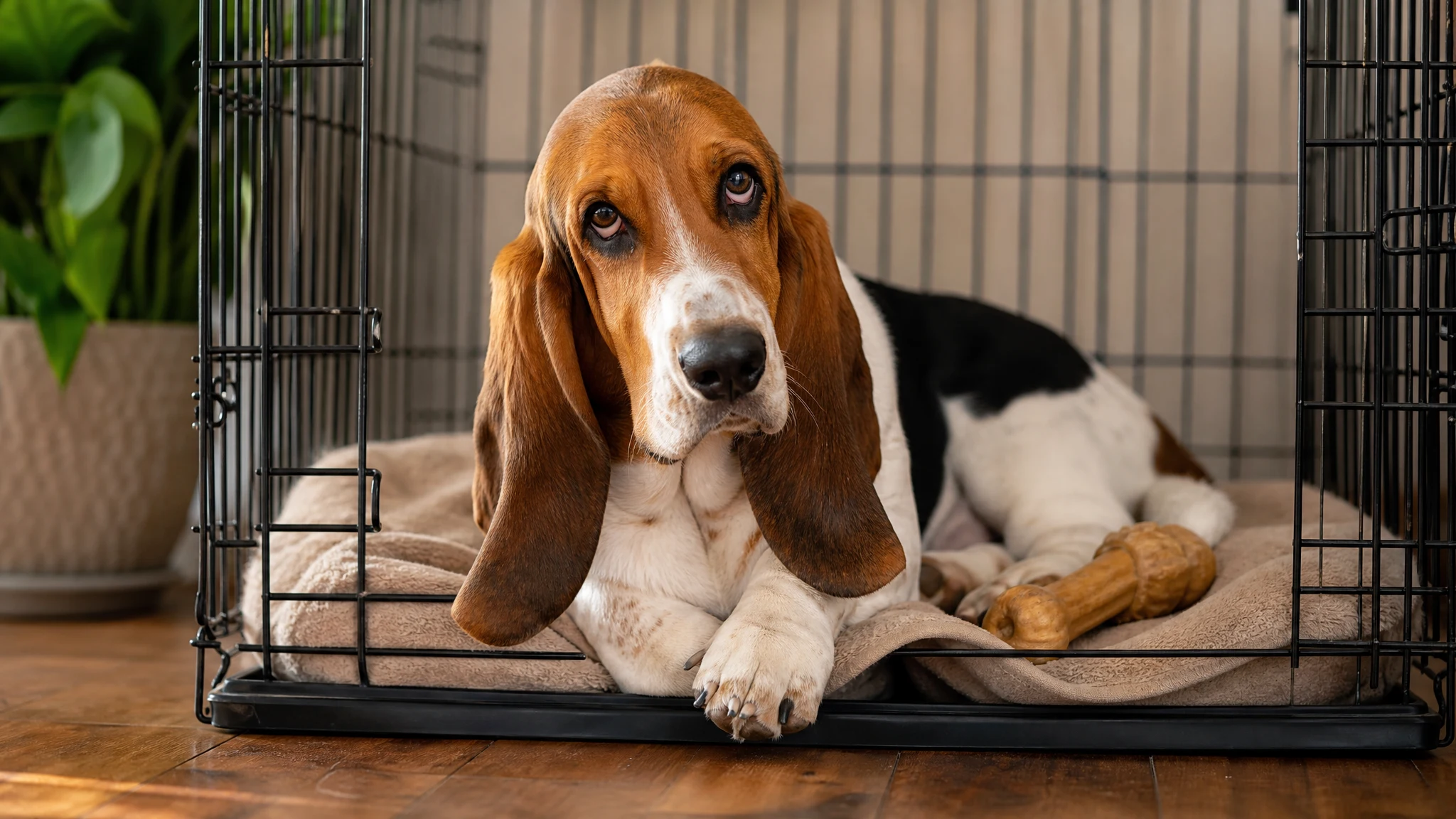
General training information. Every dog is an individual; for health or behavior concerns, see your veterinarian.
A Basset Hound does not do anything quickly, and that includes learning that a crate is a nice place to be. The good news is that the breed is food motivated, and that gives you a lot to work with.
This guide walks through basset hound crate training from the first day, then shows how to build alone time slowly so your dog learns that being by themselves is ordinary and safe. Every dog is an individual, so treat the timings below as a starting point and let your dog set the pace.
Why crate training suits this breed
The Basset Hound Club of America says the breed was developed in France to hunt small game such as rabbit and hare by scent, working in packs. That is a dog built to follow its nose and to live closely with other dogs and people. A dog like that can find a quiet, den-like space comforting, but it can also find being left alone hard.
Hill's Pet Nutrition describes the breed as not easy to train and somewhat stubborn. Vetstreet calls Bassets independent and ruled by the nose. Orvis adds that the breed howls loudly and may howl when left alone too long. Put those together and you can see why a calm, gradual plan matters more than any single trick.
Vetstreet also advises starting training the day a puppy comes home rather than waiting until 6 months, and PetMD notes that positive reinforcement works well, helped by the breed's strong food motivation. Consistency and patience are the two things to bring.
Materials you will need
- A crate of the right size. See the sizing section below.
- A thin, washable mat or blanket that fits the floor of the crate.
- Small, soft treats your dog loves, cut tiny. Count them as part of the daily food so weight stays in check. Hill's lists obesity as a concern for the breed.
- A stuffable chew toy or a few safe chews that suit your dog's size and chewing style.
- A cover or light blanket for part of the crate, if your dog likes a darker den.
- A leash and a secure, fenced area for potty trips. Orvis says Bassets must be leashed or fenced because of the urge to follow scents.
- A timer or phone so you can keep practice sessions short and honest.
Choosing the right crate size for a Basset Hound
Basset Hounds are long, low and heavy-boned, so the usual advice to size a crate by weight alone does not fit them well. The numbers also vary by source, so use ranges and not a single figure.
The United Kennel Club gives a height of 13 to 15 inches at the withers. Hill's lists males at about 14 inches and females at about 13 inches. For weight, Vetstreet lists 50 to 65 pounds in its breed details, PetMD gives 40 to 65 pounds, and Hill's text runs from 40 to 80 pounds. A puppy will grow into those numbers, and an adult can land anywhere in that spread.
What that means for the crate:
- Your adult dog should be able to stand without ducking, turn around and lie down stretched out. Measure your own dog from nose to base of tail and from floor to top of the shoulder, then compare to the crate maker's sizing chart.
- Because the breed is low to the ground but long, a crate chosen only by the weight range printed on a box may be too short for the body. Check the brand's own dimensions and guidance.
- If you buy a large crate for a growing puppy, use a divider to shrink the space for now. Too much room can make house training harder.
Step-by-step: crate training a Basset Hound
Step 1: Set up the crate in a social spot
Put the crate in a room where the family spends time, such as the living area, not a far-off hallway. A hound bred to work in a pack tends to want company. Add the mat, leave the door tied open and let your dog explore on their own terms.
Step 2: Make the crate the best place in the house
Toss a treat just inside the door while your dog watches. Let them walk in, eat it and walk out. Do this a few times in a row, then stop. Over several days, drop treats farther back. Give a calm word of praise as they step in.
Feed some meals inside the crate with the door open. Put the bowl near the entrance at first and move it back a little each time. Never push or pull your dog in, and never use the crate as a punishment.
Step 3: Add a cue
Once your dog walks in happily for treats, say a simple cue such as "crate" just as they move in, then reward. Keep your voice cheerful. A Basset's nose will often lead them in before the word means anything, and that is fine. The word catches up through repetition.
Step 4: Close the door for a moment
With your dog inside eating a treat or working on a stuffed chew, close the door for a few seconds, then open it before they fuss. Build up slowly: a few seconds, then ten, then thirty, then a minute. If your dog whines, you moved too fast. Go back to an easier step and reward calm moments.
Step 5: Stay nearby, then move around
Sit beside the crate with the door closed and read or scroll your phone. Then stand up, walk a few steps and return. Reward quiet behavior while you are in sight, then out of sight for short moments. This is where patience pays off, because an independent dog can seem fine one day and unsure the next.
Step 6: Lengthen the time and add real routine
Start using the crate for short, planned rests after exercise and after potty trips. Hill's suggests at least one good long walk daily, and Orvis suggests two to three 20-minute walks plus easy play. A dog that has had a walk and a sniff session is far more likely to settle. Take your dog straight to the potty spot when you open the door, especially during house training.
Step 7: Plan nights
For a young puppy, many owners keep the crate in the bedroom at first so the dog can hear and smell them nearby. Puppies do need potty breaks at night, and how often depends on the individual dog, so ask your veterinarian what is reasonable for your puppy's age. As your dog matures and settles, you can move the crate if you wish.
Preventing separation anxiety: building alone time
Crate training and alone-time practice work together, but they are not the same thing. A dog can love the crate and still struggle when the family leaves. Build the two skills separately, then combine them.
Teach that coming and going is boring
Pick up your keys, put them down, and sit again. Put on a coat, then take it off. Open the door and close it without leaving. Do these without any fuss so the usual signs of departure stop predicting something scary.
Practice short, real absences
Give your dog a stuffed chew in the crate or a safe resting spot, step outside for a few seconds, and come back in before they get upset. Return calmly. Do not make a big greeting. Slowly raise the time over many sessions, mixing easy ones with slightly harder ones, and keep each step small enough that your dog stays relaxed.
Do not wait for a problem
Start these exercises in the first weeks, even if your dog seems perfectly content. Practicing alone time before it is needed is far easier than repairing it after your dog has panicked.
Keep the days balanced
A tired, fed and sniffed-out dog is more likely to rest. Include a decent walk where your Basset can follow scents on a leash. Orvis notes the breed's scent drive is strong, so a slow sniffing walk can be more satisfying than a fast one. Add a few minutes of nose games at home, such as scattering treats in the grass or hiding a few around a room.
Tips for success
- Use food your dog really wants. The breed is food motivated, so small, soft treats go a long way. Adjust meals to account for them.
- Keep sessions short. Two or three minutes, several times a day, beats one long lesson.
- Stay consistent. Everyone in the home should use the same cue and the same rules.
- Expect some howling. Orvis describes the breed as a loud howler. A little vocalizing in the early days is not unusual, and a deep voice carries. Let your neighbors know you are working on it if you share walls.
- Reward quiet, not noise. Open the door or deliver the treat during a pause, not in the middle of a howl, so you do not teach that noise opens the door.
- Leave safe items only. Remove collars or tags that could catch, and choose chews suited to your dog.
Common mistakes to avoid
- Using the crate as punishment. The crate should predict good things. Reward-based training, in line with the American Veterinary Society of Animal Behavior, avoids fear and force.
- Going too fast. Jumping from a few seconds to an hour usually backfires. If your dog is upset, shorten the next session.
- Letting a crying puppy out in mid-fuss. Wait for a brief pause, then open the door, so crying does not become the key.
- Dramatic goodbyes and greetings. Big emotions can make alone time seem like a big event.
- Skipping exercise. A bored hound with unspent energy and a busy nose finds its own work.
- Leaving a dog crated for long stretches as a routine. If your schedule keeps your dog alone for many hours, plan a midday break from a family member, friend or reputable pet professional.
- Overfeeding treats. Hill's lists obesity as a concern for the breed, so count training food as part of the day's meals.
Signs of separation distress, and when to call a veterinarian
Some fussing at the start is normal. Distress is different. Watch for these patterns when your dog is left alone or is crated:
- Non-stop howling, barking or whining that does not settle
- Panting, drooling or pacing that starts as you prepare to leave
- Trying to escape the crate or room, or damaging the door, bedding or doorframes
- Accidents indoors in a dog who is otherwise house trained
- Refusing food or treats when alone, even favorites
- Extreme excitement or clinging when you return or move around the home
If you see these signs, stop pushing your dog past what they can handle. Go back to the last step they could do calmly and ask your veterinarian for advice. Accidents, drooling, appetite changes and restlessness can come from medical problems, pain or age-related changes, and only a veterinarian can sort that out. Ask your veterinarian too about a referral to a qualified behavior professional who uses reward-based methods if the problem continues. Do not give any medication or supplement unless your veterinarian prescribes or recommends it.
Avoid shock, prong or choke collars, and any harsh correction. They can worsen fear and anxiety, and they are not part of humane, reward-based training.
What results to expect
With steady practice, many Basset Hounds learn to walk into the crate on cue and rest there calmly. Over weeks, short absences may start to feel routine, and the howling that came with the early days may fade for some dogs. Others take longer, especially if they are very attached to their family or have had a rough start.
Progress is rarely a straight line. A new schedule, a house move or a change in family routine can cause a step back, and that is a cue to ease up, not a sign of failure. Your dog is an individual, and no method can promise a particular result. Go at the speed your dog can handle, and keep the crate, the chews and the leaving routine pleasant.