Leash Training a Basset Hound: Pulling, Lunging and Loose-Leash Walking
General training information. Every dog is an individual; for health or behavior concerns, see your veterinarian.
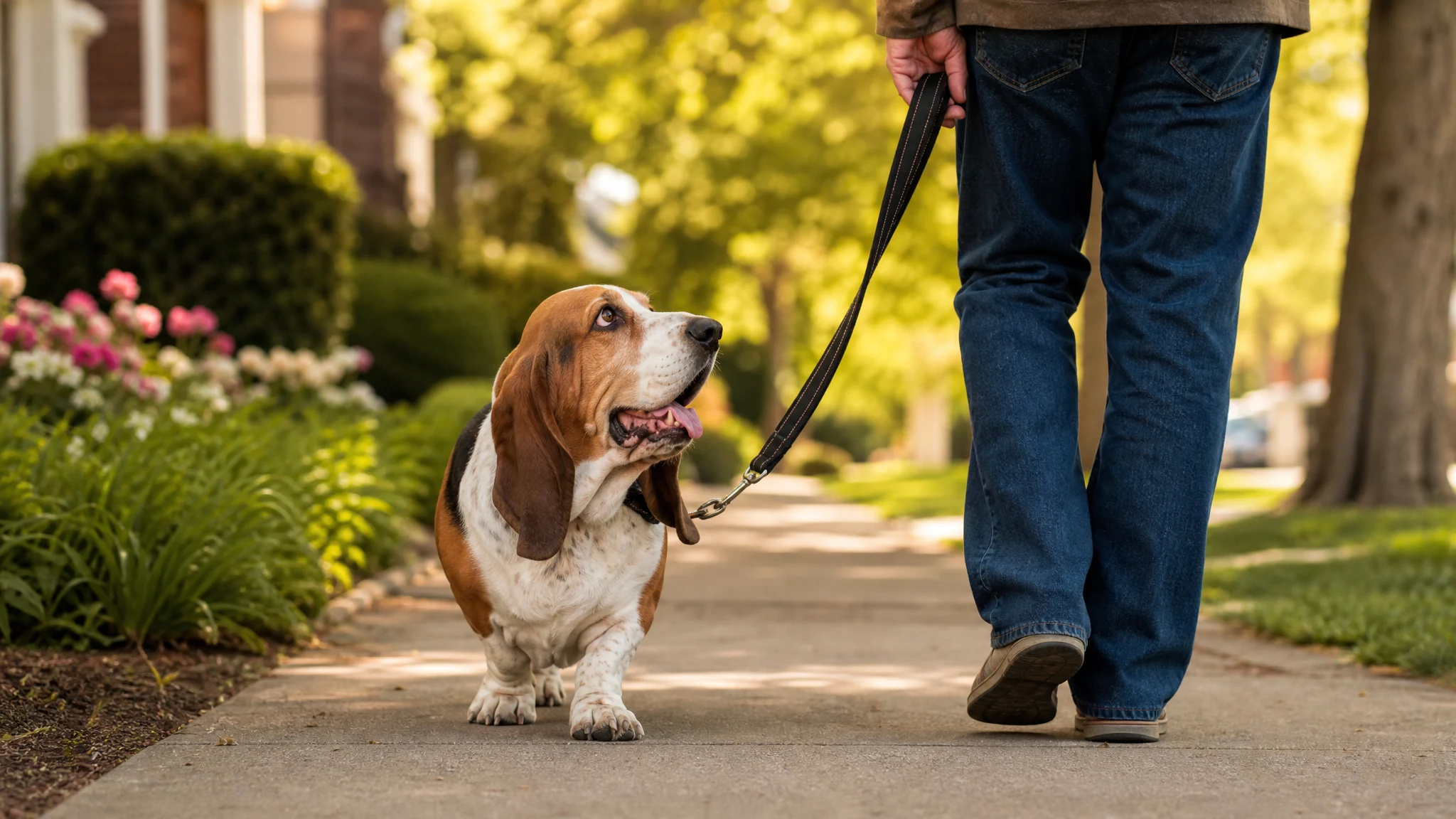
A Basset Hound on a walk is rarely heading where you are. The nose is down, the ears are sweeping the ground, and the whole dog leans toward something you cannot smell. If you are looking into Basset Hound leash training, that is probably the scene you know well.
This guide explains why the breed pulls, what gear helps, and how to teach loose-leash walking in small, repeatable steps. It also covers what to do when your dog lunges at a trigger. Every dog is an individual, so treat the timelines here as rough guides.
Why a Basset Hound Pulls
Basset Hound pulling on leash is mostly a scent story. The Basset Hound Club of America (BHCA) describes the breed as a French scent hound used to hunt small game such as rabbit and hare. Packs of Bassets worked by scent to drive prey out of dense cover for hunters on foot.
That job explains a lot. A dog bred to follow a trail with its nose will want to follow trails on your street too. Vetstreet describes the breed as good-natured and independent, and as ruled by the nose.
Orvis points out that Bassets must be leashed or fenced because of the urge to follow scents. Hill's Pet Nutrition says the breed is not easy to train and can be somewhat stubborn. The BHCA adds that these independent thinkers still do well in Obedience, Rally and Agility. So the ability is there. It just has to be worth the dog's while.
Here is the useful way to look at it. Your dog is not being rude when it drags you to a mailbox. It is doing what the breed was built to do. Your job is to make walking beside you pay better than the pull does, and to give the nose its turn at the right moments.
What You Need
- A flat collar with ID tags, fitted so you can slip two fingers under it.
- A front-clip harness, with the leash ring on the chest. Ask the shop or your veterinarian to help with fit, since a Basset's build can make some harnesses sit awkwardly.
- A standard leash, about six feet long and not retractable. Retractable leashes teach a dog that pulling extends the line.
- Small, soft treats that your dog finds exciting. Pea-sized pieces work well. PetMD notes that the breed is strongly food motivated, which helps you here.
- A treat pouch or pocket so rewards reach the dog within a second or two.
- A quiet starting place, such as a hallway, a fenced yard or an empty driveway.
- Optional: a long line of 15 to 30 feet for sniff time in a safe, enclosed area.
Skip prong collars, choke collars and shock collars. They work by causing discomfort, and they can make a dog link walks with pain or fear. Humane, reward-based training is the approach recommended by the American Veterinary Society of Animal Behavior (AVSAB). Also skip leash pops and jerks.
Count the treats as food. Hill's lists obesity among the breed's concerns, so use part of your dog's regular meal as training rewards on busy days. If you have questions about weight or diet, ask your veterinarian.
Before You Start: Set Up for Success
Vetstreet advises starting training the day a puppy comes home rather than waiting until six months. The same idea applies to an adult dog that has never learned leash manners: start now, and keep the first sessions short.
Plan on a few sessions a day of three to five minutes each. Practice before a walk, not after a long sniffing session when your dog is already worked up. Hill's suggests the breed needs a good long walk at least once a day and is not built for daily running. Orvis suggests two to three 20-minute walks plus easy play. Use the walks as your real-world practice, and the short sessions as your classroom.
How to Leash Train a Basset Hound, Step by Step
Step 1: Teach a marker word indoors
Pick a short word such as "yes" or use a clicker. Say it the instant your dog does something right, then give a treat. Repeat 10 times in a row, a few times a day. Soon your dog will perk up at the word, which gives you a precise way to say "that was it."
Step 2: Reward your dog for being near you
With your dog on a leash in a quiet room, stand still. Whenever your dog is beside you or looking at you, mark and treat at your leg. Keep rewards at the side where you want your dog to walk. This builds the habit of checking in with you.
Step 3: Add one step at a time
Take a single step. If your dog follows and the leash is slack, mark and treat. Then two steps, then three. Keep the leash loose, with a visible "J" curve between you and the dog.
Most early mistakes happen because the handler moves too far, too fast. If your dog drifts ahead and the leash tightens, stop, wait, or turn and walk the other way. Reward when your dog catches up.
Step 4: Make pulling go nowhere
This is the heart of loose-leash walking. When the leash goes tight, stop moving. Stand like a tree. Your dog gets no forward progress from tension.
The moment the leash slackens, even slightly, mark and either treat or walk on. Your dog learns two rules: a tight leash means we stop, and a slack leash means we go.
Be patient. A scent hound may test this many times in a single walk. Consistency matters more than speed here, and Vetstreet specifically recommends being consistent and patient with the breed.
Step 5: Move practice to the yard, then the street
Once your dog walks beside you for 20 or 30 steps inside, move to the yard. Then the driveway, then the quiet end of the street. Each new place adds distractions, so lower your expectations for a few days and bring better treats.
If your dog is not taking treats, the setting is probably too hard. Back up to an easier place and rebuild.
Step 6: Use sniffing as a reward
Here is where working with the breed pays off. Fighting a scent hound's nose all walk long is a losing game. Instead, make sniffing a prize.
Walk 20 steps on a loose leash, then say a release cue such as "go sniff" and let your dog explore the roadside. Then call your dog back, reward, and repeat. Your dog learns that walking nicely unlocks the thing it wants most.
Step 7: Add changes of direction
Practice turns, stops and pace changes. Say a cue like "this way," turn, and reward the dog who follows. This keeps your dog watching you rather than the ground, and it gives you an escape route if you see a trigger coming.
Loose-Leash Games to Practice
Games keep sessions fun for both of you.
- Treat scatter: toss a few treats on the grass, let your dog find them, then ask for a few steps beside you. This uses the nose in a way you control.
- Red light, green light: walk, then freeze. Reward your dog for stopping with you. Walk again.
- Follow the hand: hold a treat at your side and walk a few steps so your dog tracks your hand, then reward.
- Zigzag: change direction every few steps and reward your dog for keeping up.
- Find it: drop a treat behind you as you walk away, then cue "find it." This turns your dog's drive into a game that brings it back to your side.
Lunging at Triggers
Lunging is different from ordinary pulling. A dog may lunge toward another dog, a squirrel, a bike or a person. The cause can be excitement, frustration or fear, and the right plan depends on which one it is.
If you see a lot of lunging, or it looks like fear or aggression, talk to your veterinarian first. They can check for pain or health problems and may refer you to a qualified, reward-based trainer or behavior professional. I cannot diagnose your dog from an article, and neither can anyone else.
For ordinary excitement-based lunging, these steps can help:
- Find your dog's threshold. This is the distance at which your dog notices the trigger but can still take a treat. If your dog ignores food, you are too close.
- Reward calm looks. When your dog sees the trigger and does not react, mark and treat. Then move on.
- Add distance before it escalates. Turn and walk away, or cross the street, before your dog loses focus. It is not giving in. It keeps your dog under threshold so it can learn.
- Use the scent. A handful of treats tossed on the ground gives your dog's nose something better to do while a trigger passes.
- Close the gap slowly. Over many weeks, you can work a little nearer to the trigger, only as long as your dog stays calm.
Never yank, shout at or punish a dog that lunges. It adds stress and can make the reaction worse.
Orvis notes that the breed may howl loudly. If your dog also howls on walks, treat it like lunging: add distance, redirect to treats, and reward quiet. Do not scold.
Common Mistakes to Avoid
- Walking on a tight leash while the dog pulls. Even a few steps of forward movement teach your dog that pulling works.
- Skipping the treats too soon. Fade rewards slowly. Many dogs need them for months in distracting places.
- Training only on walks. Short practice sessions before walks make a big difference.
- Expecting the nose to switch off. The scent drive is part of the breed. Plan for sniff breaks.
- Letting the dog off leash in an unfenced area. Orvis says Bassets must be leashed or fenced because of the urge to follow scents. A dog on a trail can ignore your calls.
- Using the long line to drag the dog. It is for freedom in safe spaces, not a way to haul your dog back.
- Giving up after a bad walk. Some days are harder than others. Go back to an easier setting and try again.
- Letting family members use different rules. If one person lets the dog pull, everyone's work gets harder.
Useful Tips
- Walk after a short play session or sniff time so the first excitement has passed.
- Use your dog's regular meals for training. A hungry dog tends to work harder.
- Keep sessions short and end on a success.
- Choose walking routes with different smells, so your dog gets variety.
- Keep a log of what worked, such as treat type, location and time of day.
What Results to Expect
Many owners see small improvements within a couple of weeks of daily practice, such as a few more steps on a loose leash or a quicker return to your side. Reliable loose-leash walking in busy places often takes several months, and some dogs may never walk perfectly in the most tempting settings.
Progress is rarely a straight line. A dog that walks beautifully on Monday may drag you on Tuesday because of a fresh rabbit trail. That is normal for a scent hound, and it does not mean the training has failed.
With patient, consistent, reward-based practice, many Basset Hounds learn to walk more calmly, but results vary by dog, age and history. If you are stuck, a qualified reward-based trainer can watch your dog in person and adjust the plan.