How Much Exercise Does a Basset Hound Need? Plus Brain Games
General training information. Every dog is an individual; for health or behavior concerns, see your veterinarian.
Ask ten owners how much exercise a Basset Hound needs and you may hear ten answers. Some picture a couch potato. Others picture a nose on a leash, dragging a person across the yard at top speed. Both pictures hold a little truth.
This guide gives you a simple daily plan for Basset Hound exercise, then adds the part many owners skip: mental work that suits what this breed was built to do. Individual dogs vary, so treat every number here as a starting point, not a rule.
What the Breed Was Made to Do
The Basset Hound Club of America, the parent club, describes the breed as a French scent hound used to hunt small game such as rabbit and hare. Packs of Bassets drove prey out of dense cover for hunters on foot.
That job explains a lot. A hound that works a trail at a steady pace does not need a sprint. It needs time, a track to follow and a reason to think. The United Kennel Club groups the breed as a Scenthound, and Vetstreet describes the Basset as good-natured, independent and ruled by the nose.
So when you plan exercise, plan for two things: moving the body and using the nose.
How Much Exercise Does a Basset Hound Need?
Hill's Pet Nutrition says the breed needs a good long walk at least once a day, and that it is not built for daily running. Orvis suggests two to three walks of about 20 minutes each, plus easy play.
Put those together and a reasonable adult target looks like this:
- One longer, relaxed walk each day.
- Or two to three shorter walks of about 20 minutes, spread across the day.
- Some gentle play in a fenced yard or indoors.
Neither source gives a firm number for puppies or seniors. Hill's and Orvis do not list joint limits for growing Bassets, so ask your veterinarian how much walking, stair use and jumping is right for your puppy at each age. Do the same for an older dog or one with any health concern.
Hill's also lists obesity among the breed's challenges. Daily movement is one of the easiest ways to help keep weight in check, along with sensible portions. Your veterinarian can tell you what a healthy weight looks like for your dog.
What You Need
You do not need much. Gather these before you start:
- A sturdy flat collar or a well-fitted harness, and a standard leash. Choose gear that does not choke or cause pain.
- A long line (a lightweight leash of 15 to 30 feet) for sniffing practice in open, safe areas.
- Small, soft treats your dog finds exciting. Vetstreet notes the breed is strongly food motivated, which helps in training.
- A puzzle feeder, snuffle mat or muffin tin and tennis balls.
- A few cardboard boxes, towels or paper bags for scent games.
- A fenced yard or other secure space for off-leash play.
Step-by-Step: Build a Daily Exercise and Brain Routine
Step 1: Start With a Baseline Walk
For a week, take your dog on one long walk or two to three 20-minute walks, following the Hill's and Orvis guidance above. Keep the pace easy. Watch your dog's energy and breathing, and note how your dog acts afterward.
A dog who comes home calm and settles well is probably getting about the right amount. A dog who pesters, chews or howls may need more mental work, not just more miles.
Step 2: Turn One Walk Into a Sniff Walk
This is the single best swap you can make. On a sniff walk, you let your dog set the pace and follow the nose, within safe limits.
- Pick a quiet route with grass, trees or hedges, away from heavy traffic.
- Say a cue such as "go sniff" and let the leash go loose.
- Stand still while your dog investigates. Do not hurry or tug.
- When it is time to move on, say "let's go" and reward with a treat when your dog turns toward you.
Sniffing is work for a scent hound. A 20-minute sniff walk may tire a Basset more than a brisk 20-minute march, though results vary from dog to dog.
Step 3: Keep the Nose Safe
Orvis warns that the breed must be leashed or fenced because of the urge to follow scents. A Basset on a hot trail can ignore you completely. Treat that as normal breed behavior, not disobedience.
- Use a leash or long line any time you are outside an enclosed area.
- Check that your fence has no gaps and that the gate latches.
- Do not trust recall around roads, even for a well-trained dog.
Step 4: Add a Puzzle Feeder at Mealtime
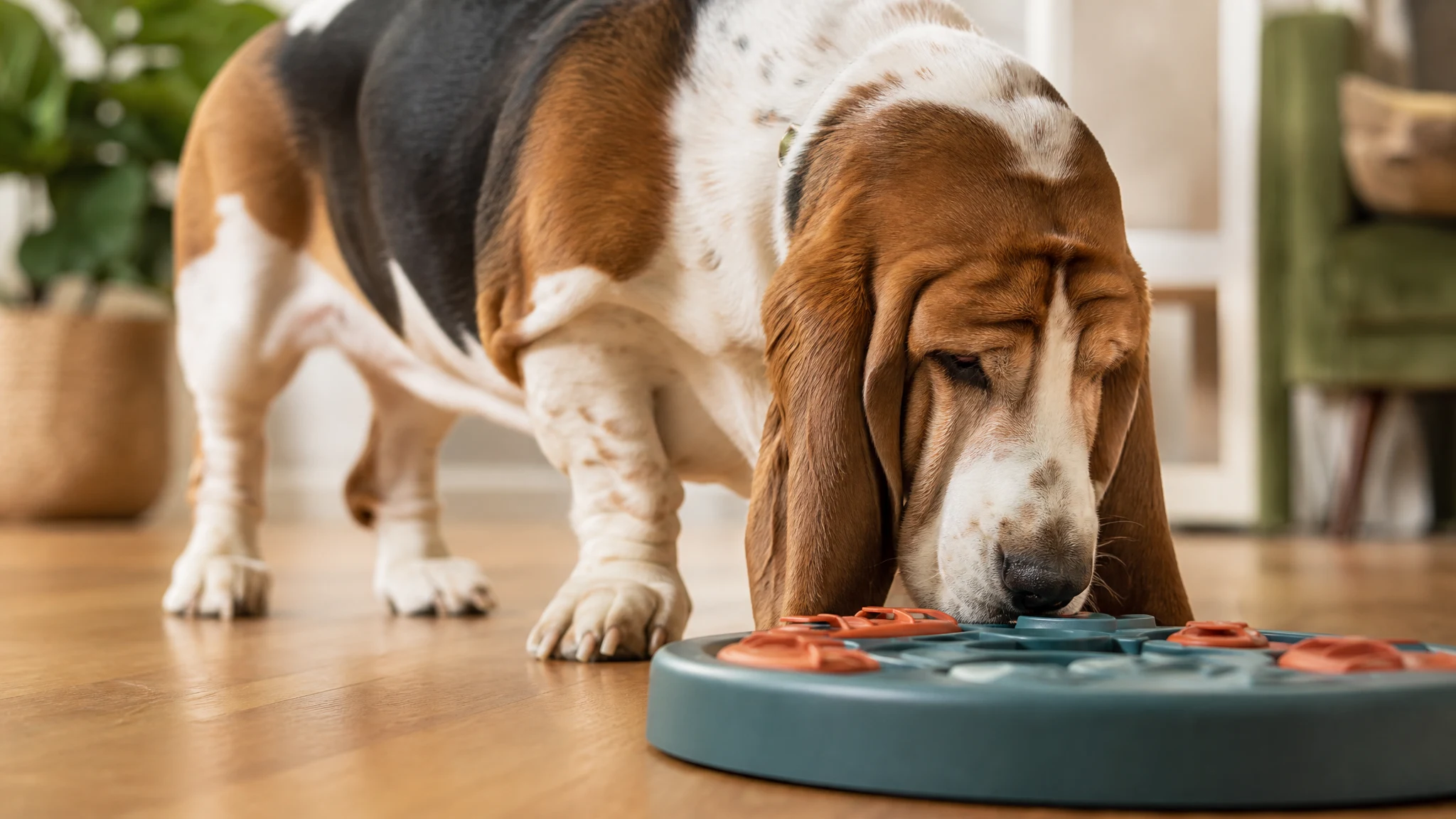
Instead of a bowl, scatter part of a meal in a snuffle mat or a puzzle feeder. Your dog has to sniff, search and problem-solve to eat. This uses the same skills the breed was developed for, and it slows down fast eaters.
Start easy. If your dog gives up, make the puzzle simpler so it ends in a win. Count the food you use as part of the day's meals so extra treats do not add weight.
Step 5: Play the Muffin Tin Game
- Put a muffin tin on the floor and drop one treat in several cups.
- Cover each cup with a tennis ball.
- Let your dog nose the balls out to find the treats.
- Add more balls and empty cups as your dog gets better.
Step 6: Play Find It With Scent Trails
This game echoes the breed's original tracking job in a small, safe way.
- Show your dog a treat, then toss it a short distance and say "find it."
- Next, hide a treat in plain sight just around a corner.
- Then hide treats under a towel, behind a chair leg or in a cardboard box.
- Finally, have a helper hold your dog while you hide a treat in another room. Release your dog with "find it" and cheer when the nose finds the prize.
Make early hiding spots easy. Praise every success. The goal is a dog that loves the search.
Step 7: Practice Short Training Games
Hill's describes the Basset as not easy to train and somewhat stubborn, and the breed club notes these are independent thinkers who still do well in Obedience, Rally and Agility. Vetstreet says to start training the day the puppy comes home, and to be consistent and patient. Positive reinforcement works well, helped by the breed's food drive.
Keep sessions to a few minutes. Try these:
- Name game: say your dog's name, then reward eye contact.
- Touch: teach your dog to bump your open palm with the nose, then reward.
- Sit and down: lure with a treat, mark the moment with a happy word, then reward.
- Leave it: reward your dog for turning away from a treat in your closed hand.
- End on a win. Stop while your dog still wants more.
- Use soft, tiny treats so you can reward often without overfeeding.
- Be patient when your dog stops to sniff. That pause is part of the exercise, not a problem to fix.
- Rotate games so they stay fresh.
- Go easy in hot weather and rest often. If you worry about heat, joints or breathing, call your veterinarian.
- Treating a Basset like a running partner. Hill's says the breed is not built for daily running. Keep the pace relaxed.
- Letting the dog off leash in an open area. Orvis points out the scent drive can pull a Basset away fast.
- Pulling the dog away from every smell. That removes the best part of the walk.
- Using food without counting it. Obesity is a listed concern for the breed per Hill's. Count treats toward daily intake.
- Forcing or punishing a stubborn dog. Harsh methods can damage trust. The American Veterinary Society of Animal Behavior supports reward-based training. Make the task easier and the reward better instead.
- Skipping mental work. A bored hound may find its own jobs, like digging or howling. Orvis notes the breed howls loudly and may do so when left alone too long.
These building blocks also support leash manners. For a wider plan, see our complete guide to Basset Hound training.
Step 8: Consider a Dog Sport for Extra Fun
The Basset Hound Club of America lists Conformation, Field Trials, Hunt Performance Tests, Tracking, Obedience, Rally, Agility and Therapy Dog work as activities for the breed. Tracking is a natural fit for a dog who loves to follow a scent. Ask the club or a local training class about beginner options and whether your dog is ready for them.
A Sample Day
Here is one way to fit this together for a healthy adult. Adjust it for your dog's age, weight and your veterinarian's advice.
| Time | Activity | Type |
|---|---|---|
| Morning | 20-minute walk, mostly sniffing | Body and nose |
| Breakfast | Puzzle feeder or snuffle mat | Mind |
| Midday | 5 minutes of Find It indoors | Nose |
| Afternoon | 20-minute walk or easy yard play | Body |
| Evening | Short training game, then a calm chew | Mind |
Tips for Better Sessions
Common Mistakes to Avoid
What You Might Expect
Results depend on your dog's age, health and habits, and no routine can promise a particular outcome. Many owners find that a steady mix of walks, sniffing and brain games may help a Basset settle more easily at home. You might notice a dog who is calmer in the evening, more engaged on walks and more interested in training.
Weight and fitness changes take weeks, not days, and your veterinarian is the right person to judge them. If your dog seems stiff, tired, in pain or reluctant to move, stop and call your veterinarian before changing the plan.
Final Thoughts
For a Basset Hound, exercise is more than steps. A long walk or a few shorter ones keep the body moving, and sniff walks, puzzle feeders and scent games feed the mind. Keep the pace easy, keep the leash on outside a fence and let that famous nose do its job.