Socializing a Basset Hound With Kids, Dogs and Strangers
General training information. Every dog is an individual; for health or behavior concerns, see your veterinarian.
Few dogs look as gentle as a Basset Hound. Those long ears and sad eyes make strangers stop and smile. But a friendly look is not the same as a well-socialized dog, and good manners with people and other dogs still have to be taught.
This guide walks you through a practical plan for Basset Hound socialization. It covers children, other dogs and new people, with clear steps, common mistakes and what you can reasonably expect.
What to Know About the Breed First
The United Kennel Club describes the Basset Hound as friendly and affectionate, and never aggressive or timid. Vetstreet calls the breed good-natured and independent, and says these dogs are ruled by the nose.
That last point matters for socializing. A Basset with a strong interest in a scent may simply ignore a person or dog you want it to meet. That is not rudeness. It is a hound doing what hounds were bred for. The Basset Hound Club of America says the breed was developed in France to hunt small game such as rabbit and hare by scent.
Many owners ask, are Basset Hounds good with kids? Individual dogs vary, and the sources we relied on do not give a rating for how the breed does with children or with other dogs. For that, talk with the Basset Hound Club of America, a breeder who health-tests and raises puppies in a home, or a rescue that has lived with the dog you are considering. Then judge your own dog by what you see.
Materials You Will Need
- A flat collar or a well-fitted harness and a standard 6-foot leash
- A long line for practice in open areas, since this breed must be leashed or fenced because of its urge to follow scents, according to Orvis
- Small, soft treats your dog loves, cut into pea-sized pieces
- A baby gate or exercise pen so your dog can rest away from visitors
- A mat or bed for "go settle" practice
- A chew or food puzzle for quiet time
- A notebook or phone notes to track what went well
Count treats as part of your dog's daily food. Hill's Pet Nutrition lists obesity as a concern for the breed, so tiny pieces are better than big ones.
Step-by-Step Socialization Plan
Step 1: Start the day your dog comes home
Vetstreet's breed profile says to begin training the day a puppy arrives rather than waiting until six months. The same goes for socialization. Start with short, calm, happy experiences at home.
Ask your veterinarian which places are safe before your puppy is fully vaccinated. Your vet knows your area and your puppy's health, so follow that advice over general rules.
Step 2: Teach three basics first
Before you add kids, dogs or crowds, teach your dog three simple skills with treats:
- Name response. Say the name once, and when your dog looks at you, give a treat.
- Settle on a mat. Reward your dog for lying on the mat, a little longer each time.
- Come away. Call your dog from a short distance and reward it for turning toward you.
These skills give you a way to interrupt and redirect when a scent or a new face pulls your dog's attention. For more on the foundation skills, see the complete Basset Hound training guide.
Step 3: Pair new things with food
The goal is for your dog to think, "New person, new place, good things happen." When your dog sees something new at a distance, such as a stranger or a stroller, give a treat the moment it looks at the thing. Do not wait for a perfect reaction.
Vetstreet notes the breed is food motivated, and positive reinforcement works well. Use that. Keep sessions to a few minutes and end while your dog is still interested.
Step 4: Introduce children in a controlled way
Start with one calm child at a time, in a quiet room, with you holding the leash or sitting close by.
- Ask the child to sit down and stay still. Let the dog approach on its own terms.
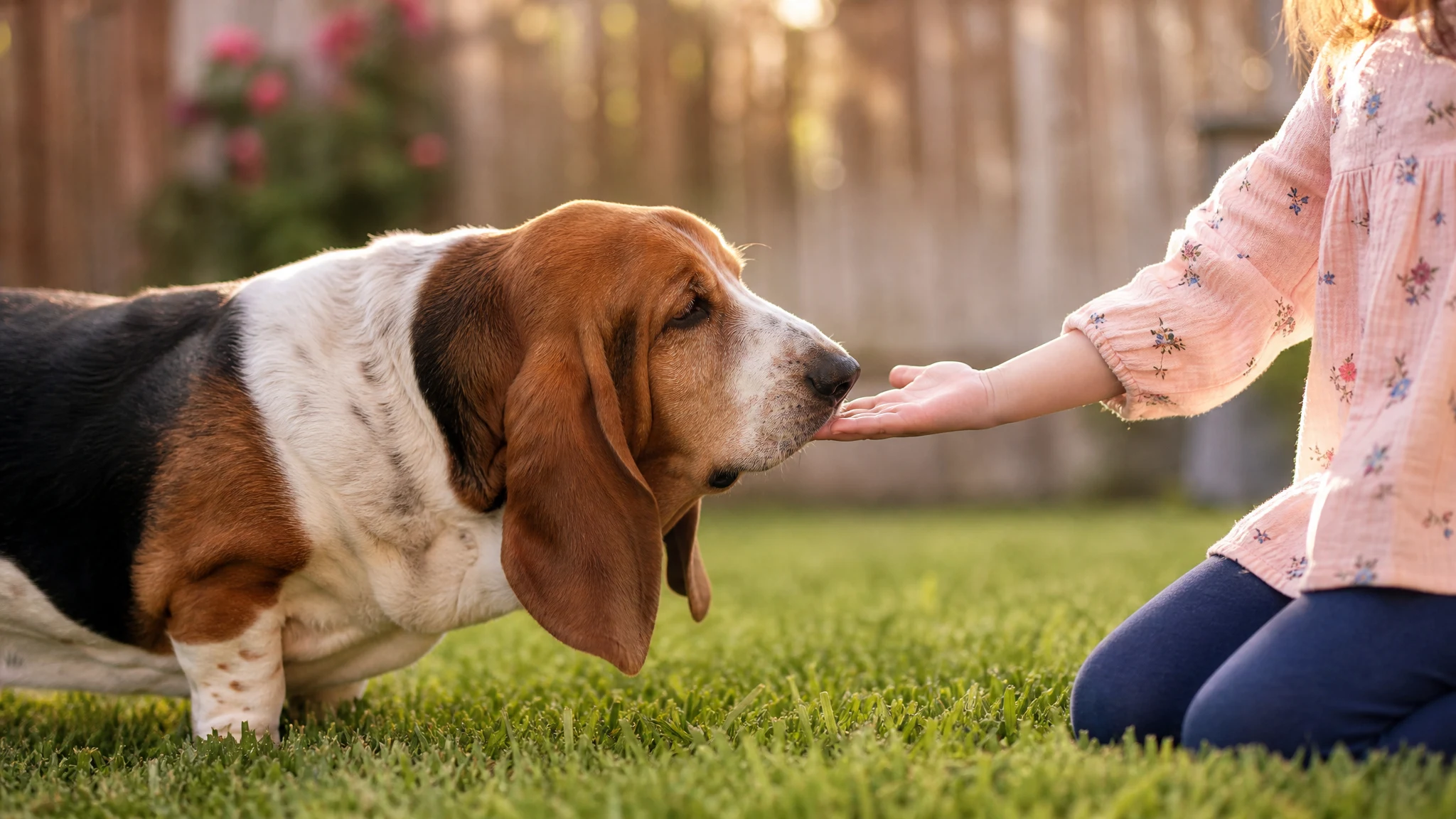
- Show the child how to hold a treat on a flat palm. Let the dog take it.
- Teach the child to pet gently on the chest or shoulder, not to grab ears, tail or face.
- Stop after a minute or two. Let the dog walk away if it wants to.
A Basset's long ears and loose skin can look like handles to a small child. Teach every child the rule: no pulling, no climbing, no hugging tight, and no bothering the dog while it eats or sleeps.
Step 5: Supervise every child and dog interaction
Active adult supervision means you are watching, within arm's reach, and not looking at your phone. Small children should never be left alone with any dog, whatever the breed.
Give your dog a place to retreat, such as a pen or a bed behind a gate. Teach children that when the dog goes there, it is left alone. A dog that has an escape route is less likely to feel it must make a point another way.
Watch for signs your dog has had enough: turning its head away, licking its lips, yawning, stiffening, or moving off. If you see these, calmly end the session and let the dog rest.
Step 6: Introduce other dogs slowly
A Basset Hound with other dogs may be keen on a sniff or may be more interested in the ground. Plan the first meetings to go well.
- Start at a distance. Walk on the same street as a calm, friendly dog, far enough apart that your dog can still take treats. Reward calm looks.
- Walk in parallel. Move in the same direction with some space between you. Parallel walking is easier than a head-on meeting.
- Allow a short, loose-leash greeting. Keep it to a few seconds, then call your dog away and reward it.
- Move to a fenced space. Once both dogs are relaxed, try a fenced yard with the leashes dragging so you can step in calmly.
- Build up. Add time and new dogs gradually, always choosing dogs with good manners.
Ask the other owner first. Avoid crowded dog parks while your dog is learning, because you cannot control the other dogs there.
Step 7: Practice with strangers
Ask visitors to ignore your dog at first. Have them toss a treat toward the dog or offer one from a flat hand, without leaning over or reaching for the head.
Practice in a variety of places over time: your front door, a quiet sidewalk, a pet-friendly store entrance. Bring plenty of treats and keep your dog on a leash. Let your dog look and sniff, and move away if it seems unsure.
Step 8: Plan for howling and excitement
Orvis describes the breed as a loud howler that may howl when left alone too long. Visitors, doorbells and new dogs can set it off. Practice short separations and settle sessions, and reward quiet. Do not yell, since that can sound like joining in.
Tips That Help
- Keep it short. Five minutes of calm practice beats half an hour of overwhelm.
- Use the nose. Scatter a few treats on the ground near a new person or place. Sniffing is calming for a scent hound and gives your dog something to do.
- Be consistent. Vetstreet and Hill's both stress patience and consistency, since the breed can be stubborn or independent.
- Exercise first. Hill's suggests at least one good long walk daily. A dog that has had a walk is easier to work with.
- Let your dog set the pace. If your dog is hesitant, add distance and try again later.
Common Mistakes to Avoid
- Assuming a gentle look means a ready dog. Sweet looks do not replace practice.
- Forcing greetings. Pushing a dog toward a child or stranger can make worry worse.
- Using harsh corrections. The American Veterinary Society of Animal Behavior (AVSAB) supports reward-based training. Punishment can make a dog more fearful around the very things you want it to like.
- Letting a child hug, ride or corner the dog. Teach children to be calm and gentle every time.
- Off-leash socializing in open areas. A Basset that catches a scent may keep going. Use a leash, long line or fence.
- Too many treats. Weight gain adds up, so adjust meals.
- Skipping rest. Tired dogs make poor choices. Plan naps between outings.
Expected Results
With steady, short practice, many Basset Hounds may become more relaxed around visitors, children and other dogs over several weeks to months. Progress is rarely a straight line. Some days your dog may seem to forget everything the moment a good smell appears.
Results depend on the dog's age, history, health and your consistency. Some dogs warm up quickly, and others need more time and distance. No plan can promise a particular outcome.
If your dog shows growling, snapping, stiff freezing or intense fear, pause the exercises and contact your veterinarian to rule out pain or illness. A qualified, reward-based trainer or veterinary behaviorist can then help with a plan for your dog. Sudden changes in behavior are a health question first.
A Simple Weekly Routine
- Daily: two or three short walks with treat rewards for calm looks at people and dogs.
- Several times a week: a mat settle session while family or visitors are around.
- Once or twice a week: a planned meeting with one calm dog or one new person.
- Every week: write down one thing that went well and one thing to adjust.
Keep expectations kind and realistic. A Basset Hound that is calm, curious and comfortable around people is built one small, happy experience at a time.